When Materials Discovery Speaks in Different Languages
Digital materials discovery has never had more powerful tools, yet the path from a promising idea to a useful electronic material is still slowed by disconnected databases, models, and workflows.
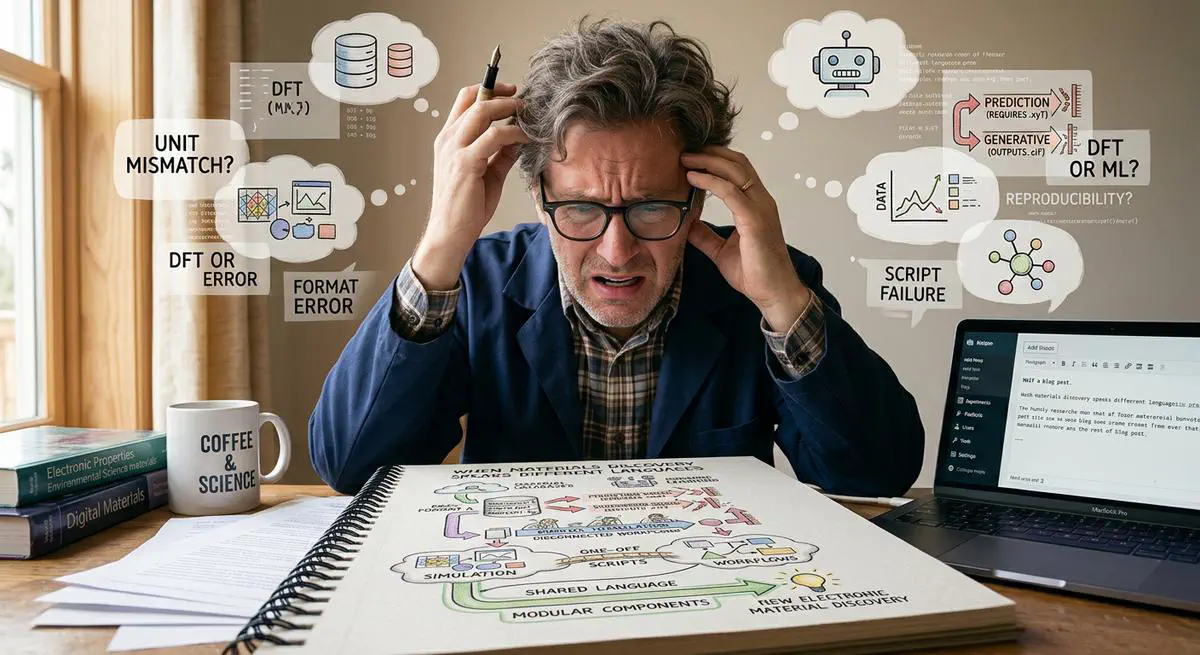 Original illustration: the many disconnected pieces of digital materials discovery
The search for better electronic materials has entered an exciting new era. Researchers can now explore enormous material databases, simulate crystal structures, estimate properties with machine learning, and even generate candidates that have never been tested in a laboratory. In principle, these tools should make discovery faster and more systematic than ever before.
In practice, the journey from an initial research question to a promising material can still feel surprisingly manual. The problem is not a shortage of useful tools. It is that many of these tools were created independently, with different assumptions, data formats, vocabularies, and ways of describing the same scientific idea.
The digital materials discovery stack
A typical electronic materials discovery workflow brings together several elements. The first is a collection of known materials. Databases may contain crystal structures, compositions, calculated properties, experimental measurements, or information about synthesis. Each source offers a valuable view of the materials landscape, but the available fields and naming conventions are rarely identical.
The second element is the simulation layer. First-principles calculations and other physics-based methods can estimate quantities such as band gaps, formation energies, stability, magnetic behaviour, and dielectric response. These calculations provide important physical insight, although they can be computationally expensive when applied to very large search spaces.
Machine learning models provide another layer. A property prediction model can rapidly estimate the behaviour of a candidate material, while a generative model can propose new compositions or structures. These models are powerful because they help researchers decide which candidates deserve closer attention. They are also dependent on the data, representation, and property definitions used to train them.
Finally, there are the practical workflow elements: filtering candidates, converting structures, checking constraints, recording predictions, visualising results, and passing selected materials to the next calculation or experiment. These steps may look like small pieces of administration, but together they determine whether a discovery pipeline is smooth or fragile.
Where the pieces stop talking
The difficulty appears when these elements need to work together. One database may call a property by a different name from a prediction model. A model may expect a particular structure representation, while the database provides another. A generative system may produce candidates that cannot be read directly by the simulation software used for validation. Even simple tasks, such as matching units or deciding whether two property names refer to the same quantity, can require careful manual intervention.
As a result, researchers often build one-off scripts around individual projects. These scripts translate files, rename fields, reshape data, and connect model outputs to the next stage. This approach can work, but it makes workflows difficult to reuse and compare. Valuable knowledge ends up hidden in notebooks, private utilities, and undocumented assumptions. Repeating the same translation work is not only time-consuming; it also creates opportunities for silent errors.
The fragmentation becomes especially visible in AI-based discovery. A prediction model may be excellent at ranking candidates, but it does not automatically know which database to search, how to interpret a property from another source, or how to pass its output to a generative model. The surrounding workflow is often left to the researcher, who becomes the translator, data engineer, and quality-control system all at once. Scientific creativity should not depend on whether every tool happens to speak the same dialect.
A need for shared language
The current ecosystem has many of the ingredients needed for faster electronic materials discovery. What is missing is a dependable way for those ingredients to connect. Common descriptions of materials and properties, predictable data contracts, and modular workflow components would make it easier to combine existing capabilities without rebuilding the connections from scratch each time.
Unifying the digital discovery landscape does not mean replacing specialised databases or models. It means allowing them to work together while preserving their individual strengths. When researchers can move smoothly from a database to a prediction, from a prediction to a generated candidate, and from a candidate to physical validation, the focus can return to the scientific question: which materials can solve the next important electronic application?

Atish Dixit
Research Fellow
My research interests include machine learning, computing and mathematical modelling.